What Happens Between Your Sessions
You are in the center for minutes a week. The adaptation you came for happens in the hours you are not. Here is what we measure in that interval — and why a bone density scan cannot tell you how it is going.
Why We Measure Inputs
A Density Scan Tells You Where You Stand. It Does Not Tell You Why.
Bone mineral density is an outcome, and a slow one. It moves over years and says almost nothing about what produced the movement. If you wait for it to answer questions, you will wait a very long time to learn something you could have acted on months earlier.
So we work the other end. Every input below changes on a scale of weeks to months, which means every one of them can be managed. The question we are trying to answer at each reassessment is not "is your bone denser yet" — it is did the mechanical dose actually land, in you, in these sessions, and if not, what stopped it.
Six Things We Watch
The Inputs That Govern Adaptation
The Load You Produced
Measured on the Spectrum every session. Peak force relative to bodyweight, and how it is progressing — not how hard it felt.
How Fast You Produced It
Rate of force development. Bone appears to respond to how quickly load is applied, not only how much — which is why a slow grind and a sharp effort are not the same stimulus.
The Raw Material
Protein, calcium, vitamin D, K2, magnesium. Loading is an instruction to build; nutrition decides whether the building can happen.
The Tissue That Moves First
Lean mass and segmental muscle. Body composition responds in weeks, long before a bone density scan will show you anything.
What Is Working Against You
Medication, hormonal status, disease context, sleep, inflammation. A strong session does not cancel an active threat to bone.
How Often, and How Spaced
Discrete maximal efforts with real recovery between them. Bone cells accommodate to loads they already experience — repetition without escalation stops counting.
We read these as separate findings, deliberately — safety first, then what is working against you, then the load itself. We do not average them into a single score. Averaging lets a strong result in one column hide a disqualifying problem in another, and that is precisely the case where the right answer is to stop adding load.
Keeping a Line Running
Body Composition Is the Input That Moves First
Of everything on this page, lean mass is the one that responds fastest and the one you can watch most easily. Your InBody 580 scan is included with your membership and stays the reference — but it happens when you come in, and muscle does not wait for your calendar.
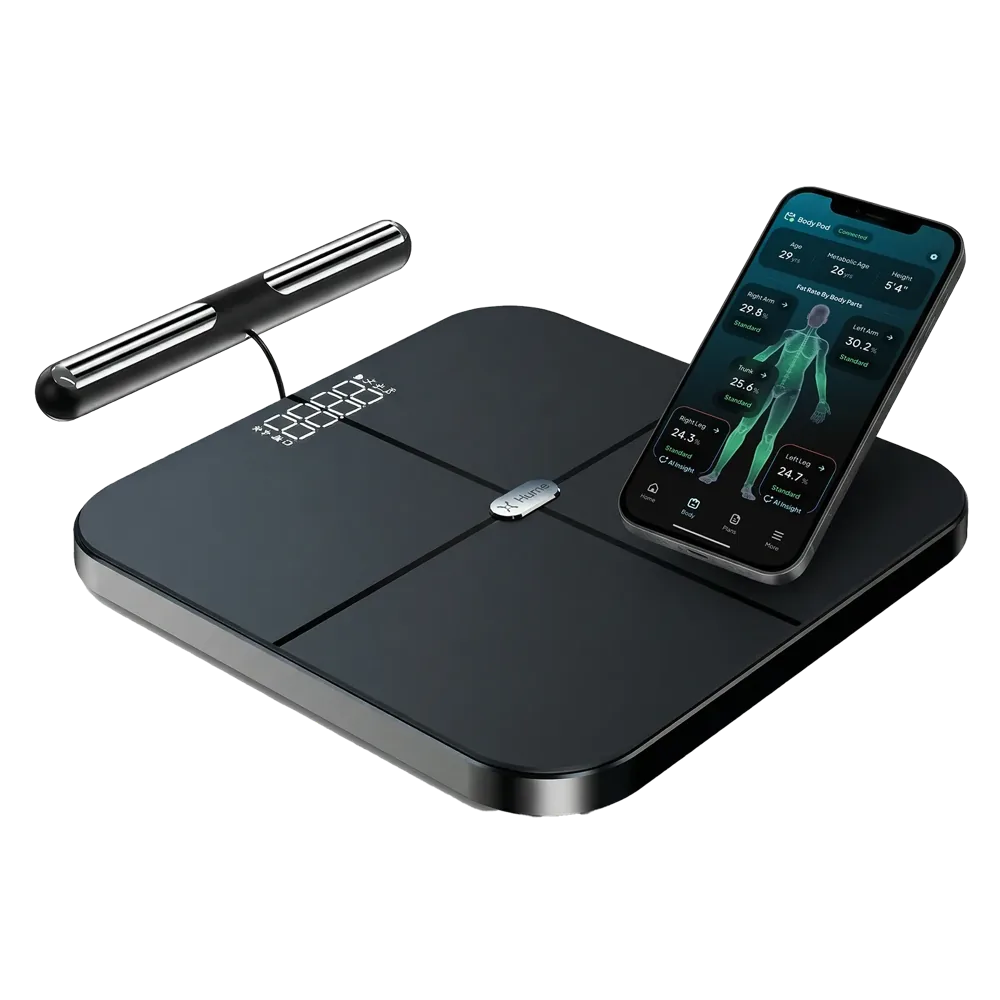
The device we recommend for the weeks in between is the Hume Health Body Pod. It is an eight-electrode smart scale — retractable handles plus a foot platform — so the current crosses your arms and trunk instead of estimating them from your legs. That is what makes its readings for segmental lean mass, skeletal muscle mass and body fat percentage worth putting on a chart at all.
One rule we will keep repeating: the Body Pod and our in-center InBody are two different instruments. They will not agree on absolute numbers, and that disagreement is not progress or regression. Each one tells you about its own trend. Your assessment record is built only from the instruments we control.
See the Hume Body Pod Write-UpVital Edge Wellness earns a small commission if you buy through the link on that page, at no additional cost to you — that is what funds the parts of membership we give away. Your in-center InBody scan remains included with membership. Hume Health and Body Pod are trademarks of their respective owner.

Straight Answers
Questions Members Actually Ask
Why not just re-scan my bone density more often?
Because it will mislead you. Bone density moves over years, and the measurement itself carries variability. Re-scan at 90 days and you are far more likely to be reading noise than change. We image bone on a set schedule and manage the inputs in between.
Is the Hume Body Pod as good as your InBody scan?
No, and it is not meant to be. Your in-center InBody 580 is the reference instrument and is included with your membership. The Hume Body Pod is a home smart scale built for frequency, not precision — a slightly noisy reading every week catches a change in direction that an accurate reading every quarter will miss entirely.
Can I compare my Hume Body Pod numbers to my InBody numbers?
Never on the same trend line. Different hardware and different equations produce different absolute values, and the gap between them is not progress or regression. Compare each device only against its own history.
Do my home Hume readings go into my OsteoStrong assessment?
No. We look at your Hume trend chart with you during a consult, and it can absolutely change what we recommend. But your assessment record is built from instruments we control and can stand behind. We keep that line clean deliberately.
What device do you recommend for tracking body composition at home?
The Hume Body Pod. It is an eight-electrode scale — hands and feet — so it reads your arms and trunk instead of estimating them from your legs, which is what makes its segmental lean mass numbers worth anything. Vital Edge Wellness has written up how to use it, and there is a link to it on this page.
What actually changes if I track between visits?
Timing. If lean mass starts drifting down, you find out in week three and fix protein in week four — instead of discovering it at a reassessment two months later with no idea when it began.
This page describes how we structure and review your program. It is educational and is not medical advice, diagnosis, or treatment, and nothing here predicts fracture or bone density outcomes.