Shockwave, StemWave, PEMF and Osteogenic Loading — What Actually Differs
They get sold as one category of “pulsed therapy”. Physically they are four different events. Here is what each one does, where its effect lands, and where it is the wrong tool — including where we are the wrong tool.

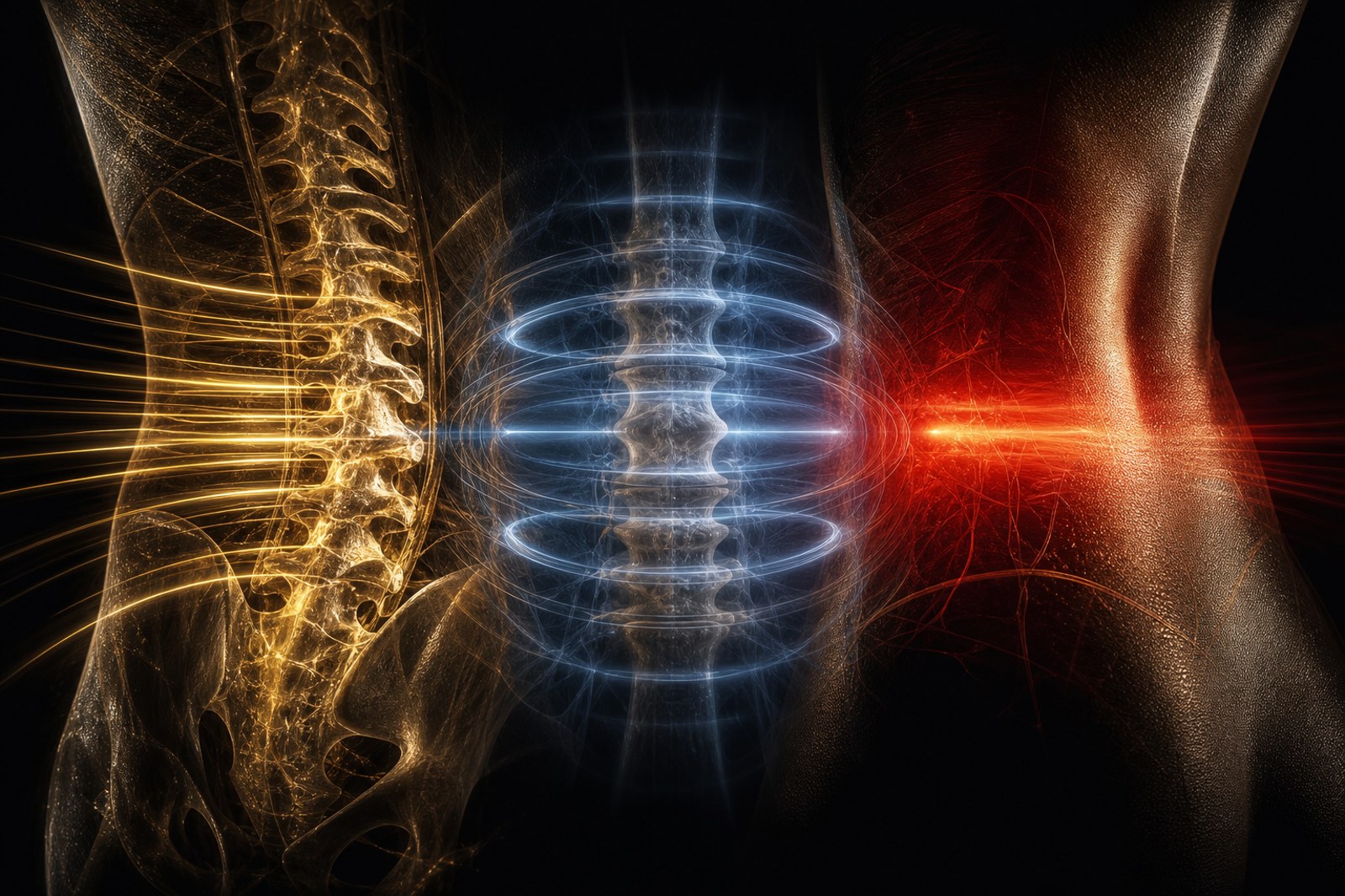
Four Devices, Four Different Physical Events
This is the whole comparison in one picture: what the device is, whether it touches you, and where in the body its effect actually lands. Depth is shown as reach, not as a number — anyone publishing exact millimetres for every device is guessing, and we would rather show you the shape of the thing honestly.
Reach is indicative and depends on the specific device, settings and the person. Shown to illustrate mechanism, not to specify treatment parameters.
Mechanotransduction — and Where the Comparison Breaks Down
There is one real overlap worth being straight about. Mechanotransduction is the process by which a cell senses a physical force and converts it into a biochemical response. Acoustic wave therapy and osteogenic loading both depend on it. Anyone telling you they are unrelated is overselling the distinction.
What separates them is dose, target and source.
Shockwave / StemWave
An external device delivers a small pressure pulse into one patch of soft tissue. The force comes from the machine, it stays local, and it is aimed at a painful structure.
Osteogenic loading (Spectrum)
You generate the force yourself, through your own skeleton, at a magnitude far beyond what a handpiece can deliver — and it travels through bone and the whole supporting chain rather than one square inch of tissue. High-magnitude skeletal loading is the specific stimulus bone adapts to.
PEMF and LIMFA — a different thing entirely
This is where the "it's all the same science" story falls apart. PEMF and LIMFA are electromagnetic. No mechanical force is applied to the tissue at all, so mechanotransduction is not the mechanism. Grouping them with acoustic devices because both are called "pulsed" is a category error.
The practical read: if mechanotransduction is what you are after, the question is how much mechanical signal you are actually getting, and to which tissue. A device pressed against your back and your own skeleton loaded near its capacity are not in the same range.
"Pulsed Therapy" Is a Marketing Category, Not a Mechanism
The word pulsed is doing a lot of work in this industry. It gets applied to devices that have almost nothing in common physically:
Acoustic pressure waves
Shockwave and StemWave send a mechanical pressure pulse through tissue. It is sound energy — you feel it, and it is applied with a handpiece against the skin.
Electromagnetic fields
PEMF and LIMFA generate a time-varying magnetic field. Nothing is pressed into the tissue; LIMFA does not contact the body at all.
Mechanical loading
Osteogenic loading is not a device applying energy to you — it is you producing force through your own skeleton. Different category entirely.
Why this matters: if you pick based on the marketing word, you can spend months on a device whose mechanism has nothing to do with your actual problem. Pick based on what you are trying to change.
What Each One Does
Shockwave / acoustic wave
What it physically is: A mechanical pressure pulse delivered through a handpiece into a specific spot of tissue.
Genuinely good at: Focal, localised soft-tissue problems — a tendon, a heel, one stubborn point that has not settled.
Where it falls short: It is a local intervention. It does nothing for the strength of the structure around the painful area, so if weakness is what keeps re-loading that tendon, the problem tends to return.
StemWave
What it physically is: A branded acoustic wave system. Same underlying physics as shockwave, delivered with its own protocol and marketing.
Genuinely good at: The same focal soft-tissue cases as shockwave generally, in a clinic set up to deliver a course of sessions.
Where it falls short: Treat the claims by category, not by brand. If a StemWave provider tells you it is fundamentally different from shockwave, ask what the physical difference is. Same structural limitation applies.
PEMF (incl. BEMER, PureWave)
What it physically is: Pulsed electromagnetic fields, usually delivered on a full-body mat. Non-contact energy, whole-body rather than pinpoint.
Genuinely good at: Circulation, recovery and general comfort across the whole body rather than one spot. Easy to combine with other work.
Where it falls short: Diffuse by nature. If you have one precise focal lesion, a targeted modality may suit it better. Also not a strength intervention.
LIMFA
What it physically is: A low-intensity, contactless magnetic-field technology used for drug-free pain and inflammation management.
Genuinely good at: People who are in too much discomfort to start strengthening work — it addresses the comfort side so the structural work becomes possible.
Where it falls short: Like the others, it improves the environment. It does not make anything stronger. On its own it is a comfort measure, not a fix.
Osteogenic loading (Spectrum)
What it physically is: You produce high force through your own skeleton in a fixed, supported position for a few seconds, with every session measured.
Genuinely good at: Building the structural capacity — bone and the supporting musculature — that everything else is compensating for.
Where it falls short: It is not a pain treatment and it is not instant. It works on a timescale of months, and it is the wrong first step if you have an acute injury or an undiagnosed pain that needs a physician.
The Difference Is the Stack
Every clinic on this list is offering you one thing that improves the environment your tissue recovers in. None of them are also loading your skeleton. That is the actual distinction — not that our device is better than their device, but that we combine the structural work with the recovery work in the same place.
If you have one focal tendon problem and nothing else going on, a course of acoustic wave therapy may well be the right call, and we will say so. If your back or hips hurt because the structure around them cannot handle what you ask of it, energy delivered to the sore spot will keep buying you temporary relief indefinitely.
Straight Answers
Is PEMF the same as shockwave therapy?
No. Shockwave delivers a mechanical acoustic pressure pulse into tissue through a handpiece. PEMF generates a time-varying electromagnetic field and does not push anything into the tissue. They are marketed similarly because both are described as 'pulsed', but the physics and the applications differ.
Is StemWave different from regular shockwave?
StemWave is a branded acoustic wave system. The underlying physics is the same category as other shockwave devices; the differences are in the device design, protocol and delivery. Evaluate claims about it the same way you would evaluate any acoustic wave provider.
Do shockwave and osteogenic loading use the same science?
Partly. Both are mechanical, and both rely on mechanotransduction — cells sensing a physical force and responding to it biochemically. The difference is dose, target and source. Shockwave applies a small external pulse to one patch of soft tissue. Osteogenic loading has you generate high force through your own skeleton, which is the specific stimulus bone adapts to. PEMF and LIMFA are not mechanotransduction at all — they are electromagnetic, with no mechanical force involved.
Which is better for back pain?
It depends on the cause. Acoustic wave therapy targets a specific painful structure. If back pain is being driven by inadequate strength in the hips, trunk and posterior chain, a focal treatment will relieve symptoms without changing the cause. Osteogenic loading works on that underlying capacity, and modalities like LIMFA and red light make the recovery side easier while you do it.
Do you offer shockwave or StemWave?
No. We do not offer shockwave or StemWave. Our modalities are the Spectrum osteogenic loading system, PEMF (including LIMFA) and red light therapy. If a focal acoustic wave treatment is genuinely what your situation calls for, we will say so during the consultation and point you toward it.
Not Sure Which One Fits Your Problem?
Tell us what hurts and how long it has been going on. We will give you an honest read on whether we are the right option — including when we are not.