Back Pain Relief in Limerick — Without Drugs or Surgery
Most back-pain care treats the symptom. We work on the structure underneath it — the strength of your spine and hips, the load your posture puts on them, and the inflammation that keeps the cycle going.
Why Back Pain Keeps Coming Back
Painkillers, adjustments, injections and rest can all quiet a flare-up. None of them make the structure carrying your spine any stronger. When the relief wears off, the same loads land on the same under-supported joints — which is why so many people cycle through treatments for years without the underlying problem changing.
Weak Support Structure
The spine does not hold itself up. Hips, posterior chain and trunk share the load. When those are weak, the spine absorbs more of it than it was built for.
Posture Under Load
How you stand and hinge decides where force ends up. Small positional faults, repeated thousands of times a day, concentrate stress on one area.
Inflammation Cycle
Irritated tissue hurts, pain makes you move less, moving less weakens the support further. Breaking that loop takes work on both ends at once.
Three Things, Working On Different Parts of the Problem
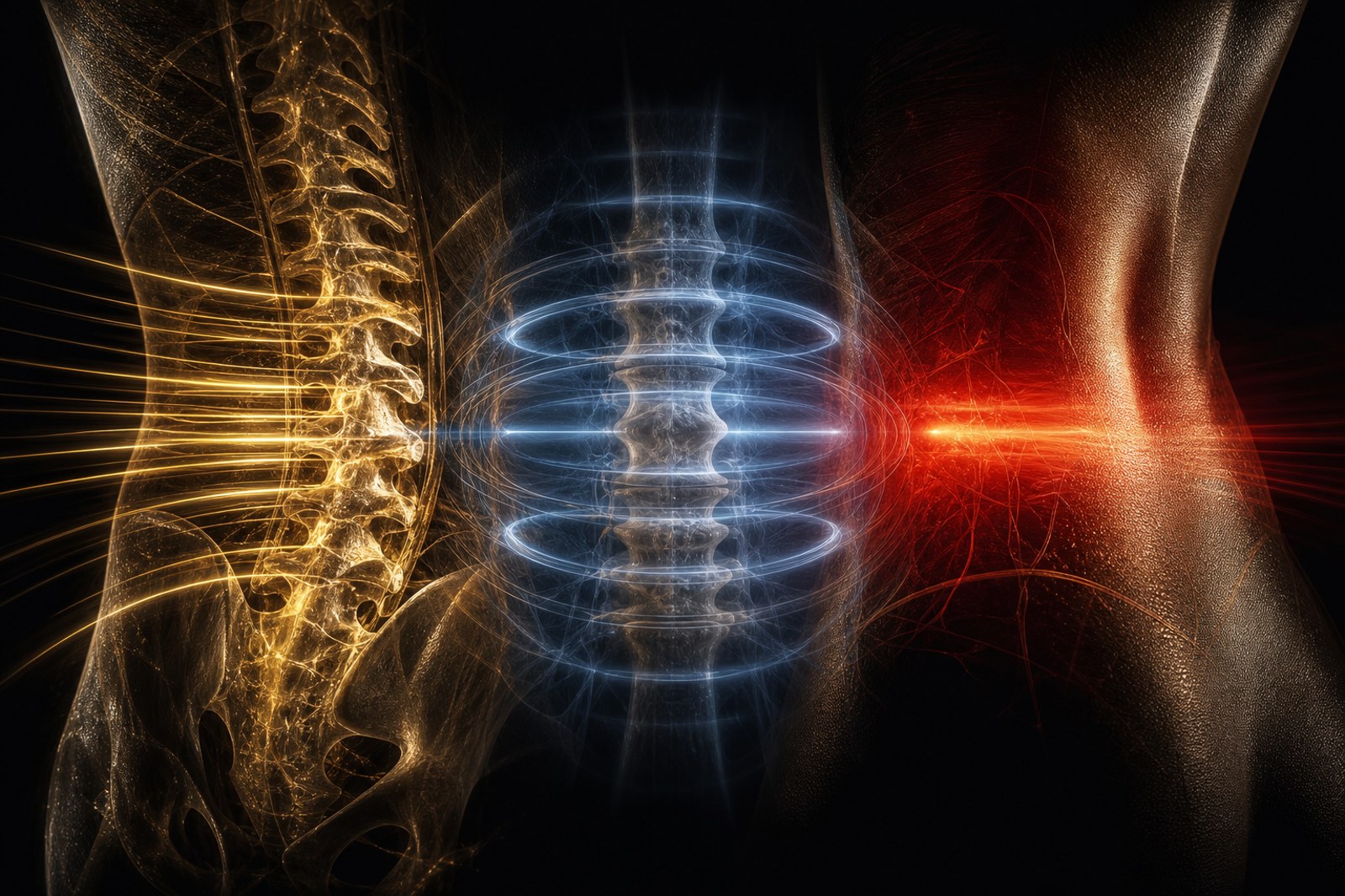
No single device fixes a back. What makes our approach different is the combination — one modality builds the structure, the others improve the environment it has to recover in.
Osteogenic Loading — the structural work
Our Spectrum system lets you produce force well above what a normal workout allows, in a controlled position, for a few seconds at a time. That mechanical stimulus is the input bone and connective tissue respond to (Wolff's Law). This is the part that changes the structure rather than managing the symptom — and it is the part nobody else in the area is doing.
Red Light Therapy — the recovery environment
Red and near-infrared light is absorbed by the mitochondria in your cells and is used to support local circulation and tissue recovery. We use it around sessions to help the areas you have just loaded recover well.
LIMFA & PEMF — the inflammation and comfort side
LIMFA is a contactless low-intensity magnetic field technology used for drug-free pain and inflammation management. It is the piece that makes the loading work tolerable for people who arrive in enough discomfort that they cannot train at all.
The honest version
We are not a pain clinic and we do not treat or cure back conditions. What we do is build the strength and structural capacity underneath the pain, in a setting where the recovery side is handled too. Some people feel a difference quickly; for others it is a gradual change over months. If your pain needs a medical diagnosis first, we will tell you that on the phone rather than sell you a membership.
Spectrum and LIMFA Solve Each Other's Problem
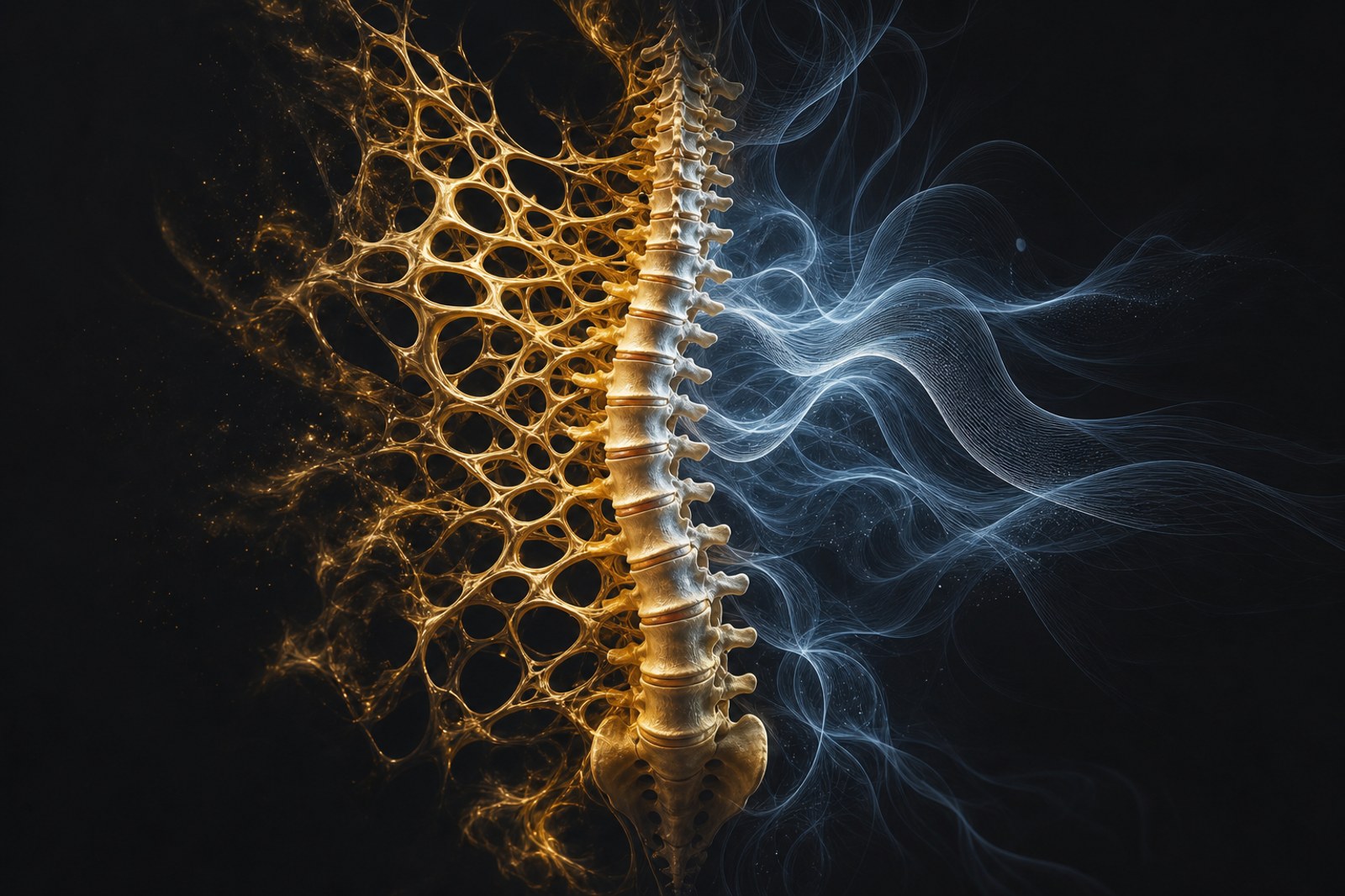
These two are not two versions of the same treatment. They do opposite jobs, and each one is limited in a way the other covers.
LIMFA's limit: it does not make anything stronger
A magnetic field can help with the comfort and inflammation side. It cannot add capacity to a spine that is being asked to do more than it can hold. Used alone, it is something you keep coming back for.
Spectrum's limit: you have to be able to do it
Osteogenic loading is the part that changes the structure — but someone arriving in real discomfort often cannot get into position and produce meaningful force. The intervention that would actually help is the one they are least able to start.
Together: comfort first, so the structural work can happen
We use LIMFA and red light to bring the discomfort down far enough that you can load properly, then use Spectrum to build the capacity that stops the cycle restarting. The loading is the point. The rest is what makes the loading possible — and what makes the week after a session easier.
One thing to be precise about
You will see shockwave, StemWave, PEMF and loading all described as "pulsed" therapies working through the same science. Only part of that is true. Shockwave and osteogenic loading are both mechanical and both work through mechanotransduction — cells responding to physical force — though at very different magnitudes and on different tissue. LIMFA and PEMF are electromagnetic: no mechanical force is involved, so that is a different mechanism, not a stronger version of the same one. We pair them because they differ.
Looking at Shockwave or StemWave Too?
Acoustic wave devices, PEMF and osteogenic loading get marketed as if they are interchangeable. They are not — they work by genuinely different mechanisms, and they are good at different things. We wrote a plain comparison so you can tell which one matches your problem, including where the others beat us.
Your First Conversation
1. A phone consultation
We talk through what hurts, how long it has been going on, and what you have already tried. This is also where we work out whether we are the right fit — sometimes the answer is no.
2. A session in the center
You see the Spectrum devices, get positioned properly, and produce your first measured force readings. Everything is recorded so you have a starting number.
3. A weekly rhythm
One short session a week, plus whichever recovery modalities make sense for you. Progress is tracked against your own baseline, not an average.
Before You Call
Can OsteoStrong help with back pain?
OsteoStrong is not a treatment for back conditions. Our sessions build strength in the hips, trunk and posterior chain that support the spine, and members frequently tell us their back feels better as that capacity improves. Whether it helps in your case depends on what is causing the pain, which is what the initial consultation is for.
Is osteogenic loading safe if my back already hurts?
Sessions are brief, performed in a fixed and supported position, and you control the force you produce — you stop where it is comfortable. That is very different from lifting a heavy free weight. If you have an acute injury or an undiagnosed pain, see your physician first; we will ask about it before you start.
How is this different from physical therapy?
Physical therapy rehabilitates an injury back to normal function. Osteogenic loading is about building capacity beyond normal, on an ongoing basis. Many of our members come to us after finishing PT, and the two work well in sequence rather than in competition.
Do you offer shockwave or StemWave?
No. We do not offer acoustic wave therapy. Our modalities are the Spectrum osteogenic loading system, LIMFA/PEMF and red light therapy. If a focal acoustic wave treatment is what your situation calls for, we will tell you that rather than sell you a membership.
How is LIMFA different from shockwave or StemWave?
Shockwave and StemWave deliver a mechanical acoustic pulse into tissue. LIMFA uses a low-intensity electromagnetic field and does not contact the body. They are different mechanisms despite both being marketed as pulsed therapies. Our comparison page explains where each one fits.
Where are you located?
OsteoStrong Limerick Central serves Limerick, Royersford, Collegeville, Pottstown, Phoenixville and the surrounding Montgomery County area.
Not sure OsteoStrong is right for you?
Fair enough — ten minutes a week sounds too easy to work, and you've probably been promised things before. So read the four-minute version first. It explains the mechanism, tells you exactly what a session is, shows what we measure, and ends with six honest questions. If none of them apply to you, it says so and tells you not to book.
Stop Managing It. Start Changing It.
One conversation tells you whether this is the right approach for your back — and we will say so if it is not.
Prefer to talk it through first? Call us — we will tell you honestly whether this fits your back.